Every year for the past 36 years or so my friend Jay and I have exchanged Christmas gifts that are trapped in some way. Open it without disarming the trap and they’ll “explode” (set off a loud cap, sometimes with accompanying flash paper), fire nerf darts, set off an alarm, or the like. For a long time I’d modify thrift-store jewelry boxes, but when I got a home laser cutter I shifted to building bespoke puzzle boxes.
I don’t want to spoil the surprise of this year’s puzzle box (and to be honest I’m still finishing it), but here’s the gift from a few years ago. It’s a thin rectangular box about 5″ long with a plug at the top that’s held in place by two wooden pegs. The pegs are cut halfway through so they can both slide in and out through their respective holes, but each peg blocks the other from being removed. Figure out how to remove the pegs and you can open the box.
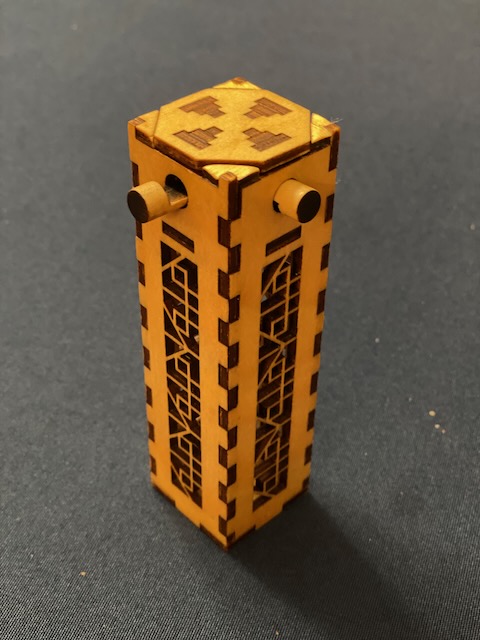
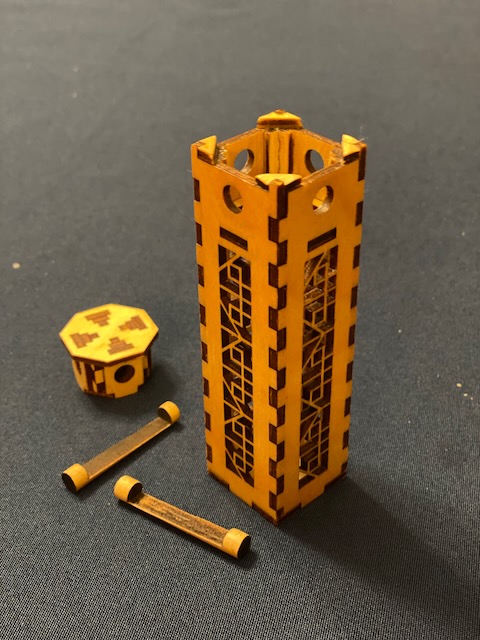
This particular design is based on a 1949 disassembly puzzle called Pick-a-Peg, which I found described in New Book of Puzzles by Slocum and Botermans (a picture of the original can be found here). After some internet sleuthing I found the 1946 patent application that describes the inner workings in detail, and from there I was able to modify the design to work with laser-cut pieces and turn the disassembly puzzle into the locking mechanism for a box. I especially like how cleanly the original puzzle works as a locking mechanism, almost like it was designed with that in mind (though as far as I can tell it wasn’t). I did a similar repurposing with the Handcuffs puzzle, but this is much nicer.
Jay opened it in about seven minutes, though of course some of that time was spent carefully checking for any hidden explosives. My one design critique is that the pegs feel too delicate, to the point where people are afraid they’ll break if they push too hard. If I do a redesign I’ll either use a larger diameter peg or switch to using brass or steel rods.