December 17, 2006

Advertising as a form of violence-- Mind and Brain --

tray-table-advertisement.jpg

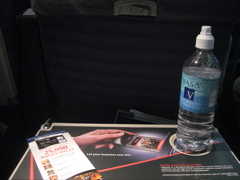
Remember the future depicted in the movie Minority Report, where every last inch of real estate is covered by advertisements that demand your attention by any means possible? I couldn't help think about that as I flew home on US Airways after Thanksgiving. First there was the TV screens, which after the safety take-off script started extolling the virtues of their Skymall shopping opportunities. Then there was the flight attendant who, having just given me potential life-saving information about the flotation abilities of my seat cushion, came through the cabin explaining how we could have a free flight if we just signed up for their co-branded credit card. Finally, just as I thought the barrage was over, I brought my tray table down only to find it was painted with yet more advertising. Good thing I've developed a strong stomach to all this advertising, because even their barf bag had ads printed on it!

It seems like everywhere there's a captive audience nowadays you'll find it stuffed full of advertising. Movie theaters have finally branched out from advertising movies and concessions to full-on TV-style ads, Wal-Mart has their Checkout TV (designed to "entertain shoppers as well as inform them about new products"), my local Longs pharmacy even has a flat-panel TV showing continuous infomercials. These ads are always delivered with the pleasant-sounding lie that they're for our benefit. If that's the case, why do they always make me feel like the airline, theater or store I'm patronizing has just punched me in the stomach?

I've tried looking past my gut reaction and thinking about the situation rationally, but oddly enough when I do that I become even more convinced that, at least most of the time, advertising is a direct form of violence. I don't mean violence in the most limited physical definition — I don't get a bloody nose from the Trix Rabbit. But consider the following points:

  1. While we like to think we make all our own choices based on the information we have at hand, in fact we humans are highly susceptible to manipulation. (In fact, there's good evidence that people who think they're not easily manipulated are the most susceptible.)

  2. Sometimes manipulations are to our long-term benefit. Education is all about changing how someone thinks; so is love. Sometimes we'll seek out ways to manipulate ourselves directly, be it by throwing out all our cigarettes so we won't be tempted to smoke or by getting drunk at a party to get over our shyness and meet someone new. Other times we won't recognize the benefit of a manipulation until much later, like the addict who denies he has a problem until his friends intervene and force him to go into detox.

    That said, commercial advertising is at best neutral about whether its message actually improves our lives. Advertisers often claim they just inform the public about products they want (if only they knew it), but their main job is to install a need for their product regardless of whether the need was there beforehand. And since creating a need where one didn't already exist takes more repetition than simply informing someone about a solution to an existing problem, most advertising we see is designed to create new needs.

  3. People are naturally resistant to having new needs installed in them. Sure it feels good when we scratch that itch by buying their product, but at some level we also know that it's the ads that made us itch in the first place. Because of this, the techniques used by advertisers are subtle and deliberately designed to manipulate our desires without our knowledge or consent.

In other words, most advertising is a deliberately deceptive manipulation of our person and our mental state, without our consent or regard for our interests. I can't see any way how that's not a form of violence. And they've been doing it all our lives, from the first toy we couldn't live without to the makeup, gadgets and junk food we crave today.

I suspect if you were punched in the stomach every day since you were a toddler, you'd think it was normal. You wouldn't like it, and no doubt you'd complain about the ones who punched especially hard or always punched you right as you were sitting down to dinner. But but somehow it'd still be seen as a price of living, nothing that could be done about it.

Only there is something we can do about it. The next time your flight attendant runs down the aisles with credit card applications shouting Who wants a roundtrip flight, absolutely free?!?, stop him and very politely explain how horrible you think it is that his company treats paying customers that way. Do the same with your local stores, and write letters to the company heads. Then take your business to those that don't have such distain for their customers.

There's no way a corporate policy of "Service with a smile and a punch in the belly" would fly. Why should advertising be given a free pass?

Posted by bug to Mind and Brain at December 17, 2006 11:40 PM
Comments

I collect instances of ad creep. Some of the places I've seen advertising that didn't advertise when I was a child include:

- Gasoline Dispenser Handles
- Gas pump displays
- Elevator displays
- Light projections on sidewalks
- Taxicab butts
- Bathroom stalls, urinals
- Airline ticket books
- Coffee cup insulator sleeves
- Taxicab displays
- supermarket checkout line seperators
- eggs
- airline barf bags
- baseball game starting times (7-11)
- manhole covers
- ATMs
- subway handles

Posted by: Rawhide at December 18, 2006 6:00 AM

[Transcribed from LJ feed comments. - 'Bug]

Advertising is coercive, but I think it can be more or less so depending on context and presentation. Newspaper ads and Google sponsored matches, for example, seem much less offensive to me than a TV in the seat in front of you playing ads.

Is it that people who think they are not easily manipulated the most susceptible, or that the most susceptible people think they're not easily manipulated? What happens when someone genuinely isn't easily manipulated -- is everyone delusional about their susceptibility?

Posted by: Dr. Tectonic at December 18, 2006 10:41 AM

It's the former — people who think they aren't easily manipulated are more susceptible than those that recognize their own vulnerability (and thus defend against it). I'll post a summary of Brad Sagarin's paper at some point, but briefly they ran a whole bunch of people through surveys about advertisements, some manipulative and some not, and with one group they merely taught how advertisements tried to manipulate people and the other group they actually proved it to the subjects by having them commit to their opinions on demonstration ads before saying "gotcha!" The group that had their vulnerability proven was much more inoculated against later ads.

Posted by: Bug at December 18, 2006 9:33 PM

If you really wanted to avoid advertising, you could pay more. Advertising saves money for the company by allowing them to sell your eyeballs to the highest bidder. I don't recall seeing anything like that number of advertisements on American or United, and that's probably because those airlines generally charge more for tickets as they're aimed at the business markets. I may also just not notice as I've been desensitized.

Newspapers are subsidized by ads, as we all know. Nobody would pay the $4 it costs to print a newspaper, but they'll happily pay the 25 cents it costs after advertising. Or compare the price of academic journals to regular magazines (e.g. Ambidextrous is $11/issue vs. $2 for Newsweek).

We can either have cheap stuff, or we can have advertising. And the vast majority of people always choose cheap, even if it distorts our existence. Yay for democratic ruling by the masses.

Posted by: Perlick at December 21, 2006 4:03 AM

"We can either have cheap stuff, or we can have advertising. And the vast majority of people always choose cheap, even if it distorts our existence. Yay for democratic ruling by the masses."

There are many ways businesses can cut costs and/or subsidize their core product. Some of these ways are acceptable to the market and some the company later discovers are unacceptable even at the reduced price. When it's a fully informed consumer decision I've nothing against that.

However, I would argue that by design advertising has a higher personal cost than we think it does. That distorts the market of advertising-based vs. other business models.

Posted by: Bug at December 21, 2006 10:28 AM

However, I would argue that by design advertising has a higher personal cost than we think it does. That distorts the market of advertising-based vs. other business models.


I'm inclined to agree. By which I mean I agree, but wouldn't want to offend anyone.


I am ever-increasingly of the opinion (and practice) that paying for lack of advertising is a good thing, at least for me, though I frame it as paying for silence.


Silence -- both the regular auditory kind and the visual kind -- is the harbinger of sanity I find increasingly missing from public space everywhere. Lack lack of sleep, I find lack of silence to be an all-too-common characteristic of modern life, and I know that for me, it leads to serious impaired function.

Posted by: Wes at January 28, 2007 7:16 PM

I don't know if the average consumer will ever be willing to pay to not see ads.

Posted by: Sarah in Orange County at June 7, 2007 1:57 PM
Post a comment


Anonymous posting is allowed, as are these HTML tags — a href, b, br, p, strong, em, ul, li, blockquote.
Email addresses are spam-protected.

You must have Javascript enabled to comment, due to the code I'm using to try to outwit spammers. Sorry for any inconvenience this may cause.

Remember Me